Health & Safety Policy for Flat Clearance Marylebone
Our company is committed to providing safe, reliable flat clearance and rubbish removal services across our service area. This policy sets out the principles and practical measures that govern safe working for flat clearance teams and for anyone affected by our work. The purpose of this document is to reduce harm, maintain compliance with applicable health and safety expectations and to promote a culture of safety across every clearance and rubbish collection task.
Safety is a core value and is treated with the same priority as quality and customer care.
Scope and commitments
This policy applies to all personnel engaged in flat clearance, waste removal and associated duties, including subcontractors working on behalf of the clearance company. Our commitments include:
preventing accidents, assessing and controlling risks, providing adequate training and resources, and ensuring that operations from initial assessment to disposal are conducted safely. We will maintain clear oversight of rubbish clearance activity and ensure that every job is planned to limit exposure to hazards.
Responsibilities and leadership
Managers and supervisors have direct responsibility for implementing safe systems of work for house clearances and rubbish collection tasks. Employees and operatives are expected to follow instructions, use protective equipment, and report hazards.
Line managers will ensure risk assessments are completed prior to any job and that control measures are in place and monitored. Training, supervision and
competence checks are part of these responsibilities, while senior management provides policy oversight, resource allocation and continuous review.
Risk assessment and control measures
Before any flat clearance or rubbish removal task we will carry out a documented risk assessment to identify hazards such as manual handling, sharp objects, hazardous substances, trip and fall risks, asbestos suspicion, electrical appliances and vehicle movement. Control measures will be proportionate and may include job-specific safe systems of work, exclusion zones, mechanical aids, and specialist handling for hazardous items. Key controls include:
- Pre-job surveys and photographic records where necessary
- Use of trolleys, lifting straps and mechanical aids to reduce manual handling
- Segregation and safe containment of sharp or hazardous items
- Clear signage, barriers and traffic management for vehicle and pedestrian safety
PPE, training and competence
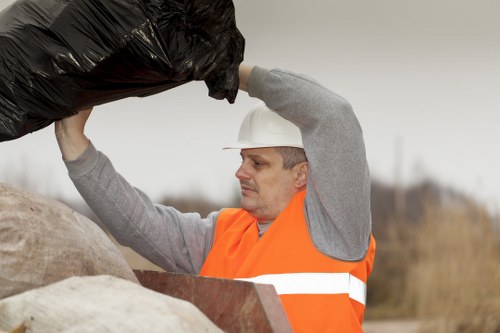
All operatives engaged in clearance and rubbish disposal will be provided with appropriate personal protective equipment (PPE) and instruction on its correct use. Typical PPE comprises high-visibility clothing, steel-toe boots, gloves suitable for waste handling, eye protection and masks when dust or biohazards are present. Training covers safe lifting techniques, recognition of hazardous waste, basic first aid, and emergency procedures. We use
competency assessments to confirm staff are capable of carrying out clearance duties without undue risk.
Handling hazardous materials
Where hazardous materials or controlled wastes are encountered during flat clearance, operatives will follow specialist handling and containment procedures. This includes secure packaging, labelling, and using approved transfer routes and disposal destinations. Any suspicion of asbestos, chemical contaminants or biological hazards triggers an immediate stop and referral to trained specialists. Our rubbish clearance teams will not attempt high-risk removal without appropriate licencing, training and equipment.
Environmental protection and waste segregation
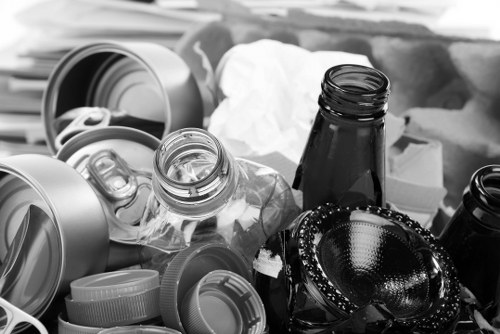
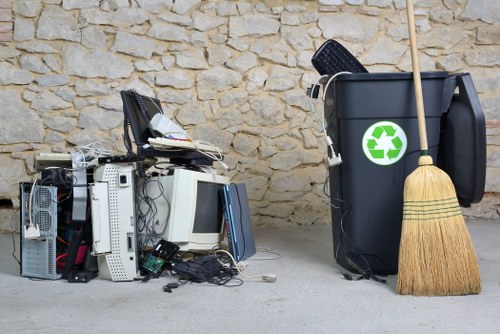
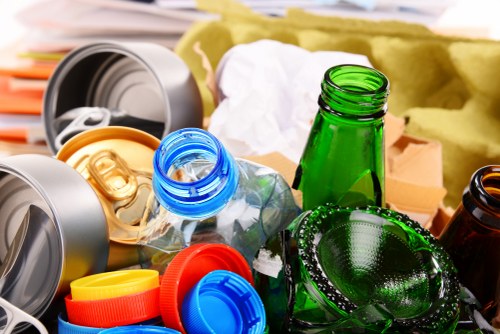
We are committed to minimising environmental impact through responsible waste segregation and reuse where practical. Materials collected during a flat clearance will be sorted to separate recyclable items, recoverable furniture and non-recyclable residues. Disposal methods are selected to meet environmental obligations and reduce landfill contribution.
Reducing, reusing and recycling are embedded in our operational approach to clearance and rubbish removal.
Transport, vehicle safety and site controls
Vehicles used for rubbish collection and flat clearance tasks will be maintained to a safe standard, inspected regularly and driven by qualified personnel. Loads will be secured, and vehicles will be operated in accordance with safe loading/unloading procedures to prevent spillage and incidents. On-site controls include permitted parking, traffic marshals where needed, and clear communications between crew members and any site occupants. Noise, dust and access impacts are managed to protect neighbours and the public.

Incident reporting, first aid and emergency response
Any accident, near miss or dangerous occurrence during clearance or waste removal must be reported immediately through our reporting system. First aid equipment and trained first-aiders will be available during operations. In the event of a significant incident, operatives will follow emergency procedures, secure the scene, and cooperate with emergency services. Lessons learned from incidents will be captured, shared and used to improve safe systems of work.
Implementation, monitoring and review
This policy will be monitored through regular site inspections, audits and performance reviews. We will consult with staff and operatives to ensure practical implementation and continuous improvement. Records of risk assessments, training, incident reports and maintenance checks will be retained to demonstrate compliance and to inform periodic policy review. The company expects all personnel to contribute to a safe working environment for flat clearances, rubbish removal and associated services across our service area. Adherence to this policy is mandatory and will be enforced through supervision and, where necessary, corrective action.